Data, data, everywhere and just no time to think

You know the refrain; ‘what does the data tell us on this’, ‘if only we had the data, we would be able to understand what’s going on here’ or my personal favourite ‘stop sending me spreadsheets, my inbox is full!’.

The use of data for decision making is not necessarily a new idea, it has really been a fundamental engine of growth since the industrial revolution.  Computers, networks and connected devices have simply accelerated the trend.  Data is everywhere, we are addicted to it: our reporting suites, spreadsheets, databases.  There is even some discussion about an on coming data storage crisis (although there are some interesting avenues of research).

Wherever you sit in a business, everyone is now being asked to analyse data to improve performance.   Be it product sales, website clicks, operational volumes or even your own performance metrics.  Reviewing data has quickly become a fundamental skill to succeed in the modern economy.

However, there is an issue…potentially a big issue.

Whilst data volumes are increasing, the hours in the day are not (really)!  Data overload is common, and when overwhelming, it becomes an obstacle to effective decision making.

Fortunately, the world of engineering and science can help for guidance. After all, they have a long history of dealing with complex data.

  1. Maximise use of existing data. All too often we are on a quest to get more.  More datapoints, more segmented data and more detail.  However before you embark on this expensive journey, have you maximised the conclusions you can draw from your existing data?  Take for example the recent Pluto flyby.  The space probe left 10 years ago, well before the invention of the iPad, there was no question of going back to update the instruments.  However, using updated techniques (for example image processing), new meaningful analysis can be gathered, enhancing our understanding of the solar system.  The same is true of a business process.
  2. The trend is your friend. ‘This is not the correct definition’, or ‘it doesn’t reconcile with the data over here’ are common frustrations and everyone has a view of what is ‘correct’.   They are both consequences of trying to take absolute measurements.  Focus on relative measures, systematic errors are removed and the conversation becomes much easier.  ‘What can we do to improve this measure by x%’
  3. Don’t waste time obtaining data accuracy levels you do not need. Being able to calculate pi to 2,000+ decimal places may be extremely interesting, and impressive, but not necessary in day to day life, even for flying to the moon. Understand how accurately you can measure something vs how accurately you need to measure something to make a decision.   It can really help and remember data is never perfect.
  4. In the absence of data, use hypotheses. Can existing data prove or disprove your hypothesis? Would this confirm your theory and is this to a level of confidence to take a decision?  This is common in the world of science, a theory is developed and existing data is reviewed, often to find that the data to confirm the thinking has been there all the time!
  5. If you do need new data, really understand the cost vs benefit. What is the cost of gathering data with greater accuracy/reporting in a new manner, vs the benefit in terms of improved decision making and business benefit over the lifetime of the expense.  In other words, do you really need to build the next CERN particle accelerator when that measurement could be completed with much simpler equipment.

Lastly a word of caution on infographics, commonly accepted thinking and easy conclusions.   Whilst they can be extremely useful, they are also very persuasive in leading you to a prescribed conclusion (or set of conclusions).  If you need speed, trust your provider and the decision is low impact, great.  If not and you are looking for new insight, testing at a deeper level is really worthwhile.

Now, don’t get me wrong, undoubtably there is joy in finding that actionable piece of insight in a sea of numbers.  For those who know me, yes I love it!  However it is worth taking a step back once in a while on our use of data to drive the business forward.

We all want to be in a data driven business, but this does not mean the data is driving the business, after all… you are.


Posted in Opinion | Tagged , | Comments Off on Data, data, everywhere and just no time to think

Why can’t the rest of the year be more like summer?

Returning to the office after the summer can be tough.

You worked hard all year and hoped to be able to take a break or at least slow down while the weather was better. You looked forward to it.

Then in a flash it is gone; the kids are back at school, the morning traffic is back to its normal crawl and finally everyone is turning up to meetings again.

Sometimes we are left thinking, “what just happened?… was it real?…and just where did the time go?”

So what type of summer was it, this year?

  • May be you couldn’t take a break and didn’t really notice the summer passing at all?…..“what summer, we never slowed down, it was just crazy busy”.
  • Or may be you did take a break, quickly falling into a relaxing routine… but in the last week realised you hadn’t done much, so ran around like mad trying to fit things in?…. “I was able to check in occasionally, but will need to work late tonight (read this week) to catch up”.
  • Or maybe you were really organised, carefully planned ahead and did everything, I mean everything… and was just so busy you did not get to relax, rest or enjoy the moment?… “Yes I know I’ve just come back, but I need a vacation to get over my vacation!…. I’m exhausted”.

Summers can be like this, and probably we’ve all had experience of these three extremes at some point.

As they say, hindsight is 20/20. So if you were to re-run the summer again, which would you prefer? If this was the only one how would you plan it differently?

It is of course an interesting analogy for life/career. Replacing the word “summer” with the word with “life” and suddenly none of these three scenarios seem very desirable at all. Certainly not great statements to be made at the end of your days.

Fortunately we get to re-run summer every year and thinking back to our most fulfilling summer holidays can give us great insight on the blend of activity we find most rewarding.

For me the holidays that worked best have been varied.  Travelling to different places, learning new things or meeting interesting people with new ideas.  All this, yet at the same time having some time each day to actually enjoy being there.

Now this may be different for everyone, and now we are back, it is a great time to reflect on your own preferrences.

Even if you had the most perfect break, by listening, adopting and continuing to include some of these elements in life and career it can help find a better balance going forward.

So as office life (not so gradually) returns to normal, reflect on your summer.  Maybe we can indeed have a little bit of it all year!

What was your lesson for 2015?

Welcome back everyone…

Posted in Opinion | Tagged , | Comments Off on Why can’t the rest of the year be more like summer?

Am I getting a good price for that? my lesson in price sensitivity

I recently had an issue with my car.

Having driven the car over significant mileage over the last 12 months and leaving aside any comments about my driving style, I needed a new clutch mechanism.

So I went off to the nearest dealer to get it assessed and fixed. Quote £2,000…. Ouch that is nearly C$4,000

It seemed extreme and rather than just accept the price, I decided to shop around.

Final competitive quote: £800, for the exact same part that was removed.

60% lower, a saving of £1,200, all for about 3 hours of my time…. Wow, all fired up and excited by my success I decided to extend this to other purchases; Car tyres: £150 vs £120, Drain cleaning: £200 vs £100, Computer cables: £11.99 vs £1.99

The size and frequency of price differences, for the what was essentially same quality of product, certainly shocked me. It got me thinking about price sensitivity and consumer price sensitivity.

Now we all know we should shop around but, especially when time strapped, it can be a hassle getting competitive quotes, do we? Sometimes you just trust the market is competitive and transparent; reliant on other people doing the leg work and driving down the price…. ‘Surely if everyone else shops around and made decisions informed by price, I will be getting a reasonable price, the quotes will be close’… right…?

… wrong! This was not the case here and some significant savings could be made. The assumption that most consumers shop around and drive down prices is clearly flawed. The market is in fact rather opaque.

This also relates to my experience in the office, where I have seen similar dynamics at work. Items such as phones can be priced to your cost centre at £350, which you know can be purchased online for £180. You question it, but often this is the agreed price, it can be frustrating.

So there are savings to be made, cash flow improved, for both consumers and businesses. So we should be more price sensitive, but when should we be? To what degree? What is the trade off vs quality and service that helps offset the higher price?

All good questions, and to help have been using the following rules of thumb.

  1. Always get at least one extra quote. Even a little shopping around can save you a lot of money.
  2. Consider local businesses as well as the big brands. I have been finding better pricing and service from small local businesses.
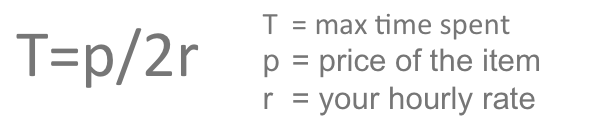
  3. Limit the time you spend depending on the price of the item. With a rough guideline below.;

Quality and service are of course important considerations too, but all things being equal there is value to be added to your business and personally, simply by taking a few extra steps.

It is time to renew our commitment to finding value.

Let me know if you have had any similar experiences or would like to add to the equation…. am sure it can be refined!

Posted in Opinion | Tagged | Comments Off on Am I getting a good price for that? my lesson in price sensitivity